
Last Updated on: 13th April 2024, 01:57 pm


J Highland
J Highland is a certified sommelier with 30 years in the liquor industry, owning a pub, a liquor store, and moonlighting as a spirits distiller.
Buffalo Trace and Eagle Rare: Exploring the differences
Written by: J Highland

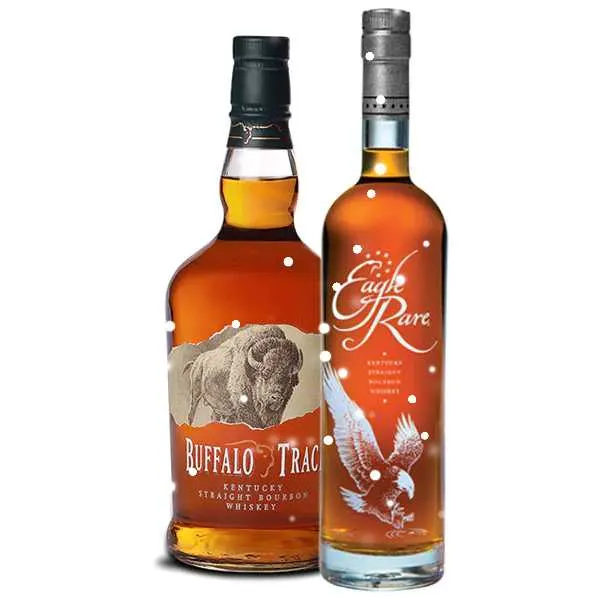
Buffalo Trace Distillery in Kentucky makes some really popular bourbons.
Two big favorites are Buffalo Trace and Eagle Rare.
While they come from the same place and start off similar, they end up tasting pretty different.
In this article, we’ll take a closer look at these two famous bourbons, how they’re made, and what makes each one special.
Key Takeaways
- Same Mash Bill: Both bourbons are made from the same mash recipe, contributing to their foundational flavor similarities.
- Aging Differences: Buffalo Trace typically ages for 6 to 8 years, while Eagle Rare undergoes a longer maturation of at least 10 years.
- Flavor Profiles: The additional aging gives Eagle Rare richer oak notes and a drier character, distinguishing it from Buffalo Trace’s more approachable and smoother profile, mentions whiskey expert Neil Coleman.
- Target Audience: Buffalo Trace is ideal for newcomers to bourbon or for use in cocktails, whereas Eagle Rare suits seasoned enthusiasts with its complex flavors.
- Award-Winning: Both bourbons have received multiple accolades, underscoring their quality and appeal.
- Quick Note: Running a pub and liquor store provides me ample access to various spirits, in addition, I moonlight as a spirits distiller. I assess them using customer feedback, expert opinions and online research.
Buffalo Trace and Eagle Rare Are Close, But Not Identical
Buffalo Trace and Eagle Rare are siblings from the same distillery and share the same mash recipe.
The two are actually pretty identical in their essence but with subtle contrasts to make them distinct.
However, they are not the same bourbon. Their aging processes differentiate their flavor profiles and textures.
Whether you choose Buffalo Trace for its easy-going charm or Eagle Rare for its matured elegance, both deliver a commendable bourbon experience, mentions bourbon expert Neil Coleman.
What makes Buffalo Trace and Eagle Rare different?
The bourbons are made using the same mash, but their aging process diverges.
While Buffalo Trace is aged for approximately 6 to 8 years, Eagle Rare enjoys a longer maturation of at least 10 years.
This extended aging process bestows Eagle Rare with richer oak notes and a drier character, especially noticeable in its finish.
In many ways, Eagle Rare can be seen as the grown-up, sophisticated sibling of Buffalo Trace.
Also read: How to Drink Buffalo Trace?
Is Eagle Rare the same recipe as Buffalo Trace?
Both Buffalo Trace and Eagle Rare are crafted from the same mash bill.
Though the recipe remains undisclosed, it’s believed to carry around 10% rye, imparting a gentle spiciness to the bourbons.
This same mash bill is also utilized for EH Taylor and Benchmark, both of which are produced at the Buffalo Trace Distillery.
The shared recipe forms the foundation for these bourbons, but it’s their aging process and other nuances that set them apart.
The Legendary Buffalo Trace Process


The distillery’s flagship bourbon has been made using the same process for over 200 years.
Buffalo Trace Kentucky Straight Bourbon Whiskey is made from a mash of yellow #2 dent corn, plump rye grains, and malted barley.
This mash is cooked and cooled before undergoing fermentation for approximately 3-5 days.
Following fermentation, the bourbon is double-distilled through column stills before maturing in first-fill, American oak barrels.
A significant 90% of the distillery’s oak comes from the Ozark Mountains, and these barrels are aged for six months in the distillery’s yard before undergoing a heavy charring process.
A meticulous selection process ensures that no more than 40 barrels at a time are chosen to create one single, small batch of Buffalo Trace Kentucky Straight Bourbon Whiskey.
This exceptional attention to detail has earned Buffalo Trace Kentucky Straight Bourbon Whiskey multiple accolades, including the Double Gold Medal in the 2014 New York World Wine & Spirits Competition and a Gold Medal in the 2014 International Wine & Spirits Competition.
Also read: Buffalo Trace Alternatives
The Splendor of Eagle Rare


Eagle Rare 10 Year Old Kentucky Straight Bourbon Whiskey is matured for a minimum of ten years in new, American oak casks under the Kentucky sun.
Eagle Rare 10 Year Old scores of 96 points from Wine Enthusiast, 95 points from Robert Parker, and the title of “Best Bourbon” at the 2013 International Wine and Spirits Competition.
Ideal Bourbon Choices for Different Palates
Buffalo Trace Bourbon is a welcoming introduction for those new to the bourbon world with its smooth and balanced profile.
Conversely, with its more intricate flavors, Eagle Rare Bourbon is better suited for the seasoned bourbon lover who can appreciate its depth.
When it comes to crafting cocktails, Buffalo Trace takes the crown.
Its balanced nature lends itself well to mixed drinks. However, it’s worth noting that while it’s a great cocktail bourbon, it isn’t my ultimate choice.
For cocktails, I gravitate towards bolder bourbons with pronounced character.
Tasting Notes: A Glimpse into Their Characters
These are the Eagle Rare and Buffalo Trace’s tasting notes:
Eagle Rare Flavors:
- Nose: Toasted oak leading the charge, underlined by hints of orange peel, red fruit, and maple syrup.
- Palate: Toasted oak remains dominant, followed by vanilla, dried fruit, caramel, and baking spice. The texture is oily, creating a satisfying mouthfeel.
- Finish: It offers a prolonged experience with a pleasant bite and leaves hints of oak, seasoned leather, and tobacco.
Buffalo Trace Flavors:
- Nose: Gentle waves of caramel, and vanilla, with a hint of baking spice.
- Palate: Spice is more pronounced, accompanied by oak and fruit nuances. The ever-present caramel and vanilla maintain the bourbon’s balance.
- Finish: Moderately long, featuring vanilla and baking spice.
Alcohol Content
Both bourbons are bottled at 90 proof.
This strength is the benchmark for what I consider good bourbon. Bourbon bottled at a mere 80 proof often feels thin and diluted, lacking the robust character that a 90-proof bourbon delivers.